Your cart is empty
Tax included and shipping calculated at checkout

Drawer menu
Tax included and shipping calculated at checkout


Thank you for shopping with Pressha. Here's everything you need to know.
Order Processing All orders are processed within 24–48 hours (excluding weekends and holidays). You'll receive a tracking email once shipped.
Lost or Damaged Packages Contact us within 48 hours of delivery at info@pressha.co with your order number and photos.
Your piercing is an investment. Protect it.
At Pressha, we source our jewelry from implant-grade titanium (ASTM F136) and 316L surgical steel — materials designed to work with your body, not against it. But even the best jewelry needs proper care. Follow this guide to heal faster, avoid irritation, and keep your piercing looking flawless.
Clean your piercing twice daily — morning and night:
Always avoid: alcohol, hydrogen peroxide, Bactine, and antibacterial soaps — these damage healing tissue.
Healing times vary by person and aftercare. Initial healing (surface) happens faster than full internal healing — don't change jewelry based on surface appearance alone.
| Piercing | Healing Time |
|---|---|
| Earlobe | 6–8 weeks |
| Upper Lobe | 8–10 weeks |
| Helix / Cartilage | 3–12 months |
| Tragus / Anti-Tragus | 3–6 months |
| Conch | 3–9 months |
| Daith / Rook | 6–12 months |
| Industrial | 6–12 months |
| Piercing | Healing Time |
|---|---|
| Eyebrow | 6–8 weeks |
| Nostril | 2–8 months |
| Septum | 6–8 weeks |
| Lip (Labret / Side) | 6–8 weeks |
| Bridge | 8–12 weeks |
| Cheek / Dahlia | 4–6 months |
| Piercing | Healing Time |
|---|---|
| Tongue / Smiley (Oral) | 3–6 weeks |
| Navel (Belly Button) | 6–9 months |
| Nipple | 6–12 months |
| Surface Piercings | 6–12 months |
| Genital | 4 weeks – 6 months+ |
Not all body jewelry is created equal. All Pressha pieces are made from:
If you've had reactions to jewelry before, implant-grade titanium is your best choice.
These are all normal — don't panic:
See a piercer or doctor if you notice:
Do not remove the jewelry yourself if you suspect an infection — this can trap bacteria inside.
Only change jewelry once your piercing is fully healed — not just feeling fine. Changing too early is the #1 cause of setbacks.
When you're ready to switch it up, shop our full collection of implant-grade titanium and surgical steel styles at pressha.co.
Ready to upgrade your jewelry? Browse our full collection of body-safe pieces.
Shop Pressha →
Every piece is held to the same non-negotiable standard. Because what goes in your body matters.
✓ Implant-Grade Titanium — ASTM F136 certified. 100% nickel-free. Hypoallergenic and biocompatible.
✓ 316L Surgical Steel — Medical-grade. Strong, corrosion-resistant, and smooth. Suitable for most healed piercings.
✓ Internally Threaded — No exposed threads. Smoother insertion, safer fit, less irritation.
✓ 24K Gold PVD Coating — Vacuum-bonded. Won’t chip, fade, or tarnish with normal wear.
✓ Certified Suppliers Only — Sourced exclusively from ASTM F136 & ISO 10993 certified suppliers.
Implant-Grade Titanium (ASTM F136) — 100% nickel-free, hypoallergenic, lightweight, and corrosion-resistant. Safe for fresh and healed piercings.
316L Surgical Steel — Strong, corrosion-resistant, and smooth. Suitable for most healed piercings. Contains trace nickel — those with nickel sensitivity should choose titanium.
PVD Coating — Physical Vapor Deposition finish. More durable than traditional plating. Available in Gold, Rose Gold, and Black.
Gemstones — Cubic Zirconia (CZ), crystal, or synthetic opal accents set in secure surgical steel or titanium settings.
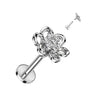
Not sure what size you need? We've got you. Use this guide to find your fit — and when in doubt, always check with your piercer for your exact gauge and anatomy.
Different jewelry styles are measured differently. Here’s how to get it right:
| Jewelry Type | What to Measure | How |
|---|---|---|
| Straight & Curved Barbells (tongue, navel, eyebrow) |
Wearable length | Measure the straight-line distance between the balls or decorative ends — not the total bar length |
| Hoops & Captive Bead Rings (septum, ear) |
Internal diameter | Measure across the inside of the ring at its widest point, from inner edge to inner edge |
| Labrets & Flat-Back Studs (lip, tragus, cartilage) |
Post length | Measure from the back of the flat disc to the bottom of the ball or decorative top |
Tip: Gauge (thickness) is always measured the same way regardless of style — it’s the diameter of the post or bar itself. The lower the gauge number, the thicker the jewelry (14G is thicker than 16G).
| Measurement | Standard Size | Notes |
|---|---|---|
| Gauge | 16G (1.2mm) | Most common — used by most piercers |
| Gauge — thicker | 14G (1.6mm) | Less common, some piercers prefer this |
| Diameter — snug | 5/16" (8mm) | Close-to-nose, minimal drop |
| Diameter — standard | 3/8" (10mm) | Most common healed fit |
| Diameter — range | 6mm–12mm | Varies by anatomy and personal preference |
Tip: 16G / 8–10mm fits most people. If you’re unsure, check with your piercer — they’ll know your exact gauge and anatomy.
| Measurement | Standard Size | Notes |
|---|---|---|
| Gauge — most common | 20G (0.8mm) | Standard for most nostril studs |
| Gauge — slightly thicker | 18G (1.0mm) | Common alternative, slightly more durable |
| Stud length (wearable) | 1/4" (6mm) – 5/16" (8mm) | Standard nostril depth range |
| Hoop diameter — snug | 6mm | Close-fitting, minimal drop |
| Hoop diameter — standard | 8mm | Most common hoop fit for nostrils |
Nose jewelry comes in several styles: nose screws, L-shaped pins, seamless rings, and hinged hoops. All fit the same gauge piercing — it’s just a matter of preference. 20G is the most common for standard studs.
| Style | Standard Gauge | Standard Length | Notes |
|---|---|---|---|
| Labret stud | 16G (1.2mm) | 5/16" (8mm) | Most common healed labret size |
| Labret — initial | 16G (1.2mm) | 3/8" (10mm) | Longer for swelling during healing |
| Monroe / Madonna | 16G (1.2mm) | 5/16"–3/8" | Upper lip placement |
| Lip ring (hoop) | 16G (1.2mm) | 5/16"–3/8" diameter | Seamless or hinged hoop styles |
Tip: After healing, most people downsize their labret from 3/8" to 5/16" for a snugger, more comfortable fit.
| Measurement | Standard Size | Notes |
|---|---|---|
| Gauge | 14G (1.6mm) | Universal standard for tongue piercings |
| Initial length | 3/4" – 7/8" (19–22mm) | Longer to allow for significant swelling during healing |
| Healed length | 5/8" (16mm) | Most common size once swelling subsides (2–4 weeks) |
| Shorter healed | 1/2" (12mm) | For thinner tongues or snugger fit |
Tip: Tongue piercings swell significantly — always start with a longer bar (19–22mm) and downsize to 16mm once fully healed. A bar that’s too short on a swollen tongue can embed into the tissue and cause serious damage. Bar length also varies depending on tongue thickness — your piercer will size you correctly at the initial appointment.
| Measurement | Standard Size | Notes |
|---|---|---|
| Gauge | 16G | Standard daith gauge |
| Diameter | 5/16"–3/8" (8–10mm) | Depends on ear anatomy |
| Measurement | Standard Size | Notes |
|---|---|---|
| Gauge | 14G | Universal standard for navel piercings |
| Shaft Length | 3/8" (10mm) | Most common — fits standard anatomy |
| Longer shaft | 7/16" (11mm) | For deeper navels or during pregnancy |
| Measurement | Standard Size | Notes |
|---|---|---|
| Gauge | 14G (1.6mm) | Standard thickness for nipple piercings |
| Initial length | 5/8" (16mm) | Standard for fresh piercings — allows room for swelling |
| Healed — short | 3/8" (10mm) | Snug fit once fully healed |
| Healed — medium | 1/2" (12mm) | Most popular healed size |
| Healed — longer | 9/16" (14mm) | For more comfort or larger anatomy |
Tip: Most people downsize from 5/8" to a shorter bar (1/2" or 9/16") after their piercing is fully healed for a more comfortable, flush fit.
All cartilage placements typically use 16G (1.2mm) as the standard gauge unless noted. Here’s a full breakdown by placement:
| Placement | Standard Gauge | Standard Size | Jewelry Style | Notes |
|---|---|---|---|---|
| Helix (Upper Rim) | 16G | 1/4" (6mm) – 5/16" (8mm) | Barbell or hoop | Most popular cartilage piercing |
| Tragus (Front Nook) | 16G | 1/4" (6mm) – 5/16" (8mm) | Flat-back stud | Small flap in front of ear canal |
| Conch (Inner Bowl) | 16G or 14G | Stud: 1/4" (6mm) – 3/8" (10mm) Hoop: 3/8" (10mm) – 1/2" (12mm) |
Stud or hoop | Longer post for initial swelling; larger hoop diameter for inner conch anatomy |
| Rook | 16G | 5/16" (8mm) – 3/8" (10mm) | Ring or curved barbell | Inner ridge above daith |
| Industrial (Scaffold) | 14G (1.6mm) standard; 16G sometimes used | Length: 1-1/4" (32mm), 1-3/8" (35mm), or 1-1/2" (38mm) Ball size: 5mm or 6mm |
Straight barbell | Exact length depends on ear anatomy. Longer bar used initially for swelling — a professional piercer can fit a shorter custom bar after healing |
Tip: Cartilage piercings can be worn with hoops, flat-back studs, or curved barbells depending on placement. When in doubt, ask your piercer what style suits your anatomy best.
Still not sure? Contact us and we'll help you find your perfect fit. 💜
Your piercings deserve more than basic fashion jewelry. Every Pressha piece is crafted from certified ASTM F-136 implant-grade titanium and 316L surgical steel—the gold standards recommended by professional piercers. Hypoallergenic, 100% waterproof, and tarnish-free, because you shouldn't have to choose between style and skin safety.